


Below is the list of Verbs generally followed by an infinitive with to
agree
appear - e.g Her health appeared to be worse
arrange
ask
attempt
care
claim
dare
decide - e.g We decided to go to Hawaii
demand
deserve
endeavor
expect
fail
get
grow
happen
hasten
help
hesitate
hope
hurry
intend
leap
learn
long
make (passive)
manage
neglect
offer
pay
plan - e.g We plan to go to India this year
pledge
pretend
refuse - e.g: I refuse(verb) to lie(infinitive) to my friends
resolve
say
seek
seem
struggle
swear
tend
vow
want
would like - e.g We would like to leave now
wish
yearn
Verbs + infinitive with to or a gerund:
attempt
begin - e.g He began singing; He began to sing
can't bear
continue
dread - e.g She dreaded taking the risk; She dreaded to think of the consequences of her actions
forget
go on
hate
intend
love - e.g She loves to dance; She loves dancing
mean
plan
prefer
propose
regret
remember
start
stop - e.g He stopped drinking; He stopped to rest for a few minutes
try
Verbs + object + infinitive with to or a gerund
admit
allow
consider
forbid
imagine
keep(in order to) - e.g The attackers kept hostages to prevent the police from entering; She kept talking.
need - e.g He need to call his boss; The house needs cleaning
permit
require
Tuesday, October 30, 2007
Tuesday, June 19, 2007
Usage of One
In sentences that contain the phrase one of.....
1. In simple form one of or one of the, a singular verb is used.
e.g - One of the books is missing from my cupboard.
2. In sentences that contain phrases one of those who or one of the things that, a plural verb is used.
e.g - He is one of our employees who are always alert.
3. When only precedes one of /one of those, a singular verb is used. (Do not mix this rule with the 2nd rule stated above)
e.g - Ram is the only one of our employees who is always alert.
1. In simple form one of or one of the, a singular verb is used.
e.g - One of the books is missing from my cupboard.
2. In sentences that contain phrases one of those who or one of the things that, a plural verb is used.
e.g - He is one of our employees who are always alert.
3. When only precedes one of /one of those, a singular verb is used. (Do not mix this rule with the 2nd rule stated above)
e.g - Ram is the only one of our employees who is always alert.


Monday, April 02, 2007
Aim to vs Aim at
Aim to (idiom)
Try or intend to do something.
- We aim to please our customers.
- She aims to fly to California.
Aim at (idiom)
Direct a missile or criticism at something or someone.
- In his last speech the President took aim at the opposition leader.
- He aims at finishing tomorrow.

Saturday, March 17, 2007
Different from vs Different than
Different from means not the same.
e.g. Sara's taste is different from mine.
Different than: In US English, than is an alternative to from before a clause.
e.g. Sara's appearance was very different than I'd expected.
NOTE : On GMAT different than is always wrong when comparing two nouns.
Different than is only correct when a sentence compares a noun and a clause.
On GMAT sentence correction if you come across a question comparing two nouns and a choice with the phrase different than eliminate that choice.
Since the 18th century, language critics have singled out different than as incorrect.

Monday, January 22, 2007
Editing Comma Splice
Comma splice is the error of joining two independent clauses with nothing but a comma.
Comma splice has two main forms -
1). Run on sentence joined by a comma alone. (Run on sentences are independent clauses that have not been joined correctly).
e.g - Some gourmets like the new French cooking, others find it dull. - incorrect - comma splice run-on.
2). Run on sentence joined by a comma and a word that is not a coordinating conjunction.
e.g - Some gourmets like the new French cooking, however, others find it dull. - incorrect - comma splice run-on.
There are 4 ways to revise a run on sentence.
1). Use a comma and a coordinating conjunction.
e.g - Some gourmets like the new French cooking, but others find it dull. - Correct
2). Make the clauses into seperate sentences.
e.g - Some gourmets like the new French cooking. Others find it dull. - Correct
3). Restructure the sentence i.e convert an independent clause to subordinate/dependent clause.
e.g - Although some gourmets like the new French cooking, others find it dull. - Correct
4). Use a semicolon.
e.g -
Some gourmets like the new French cooking; others find it dull. - Correct
OR
Some gourmets like the new French cooking; however, others find it dull. - Correct.
OG 10th - Ques number 10 - Example of Comma splice run-on.
10. However much United States voters may agree that there is waste in government and that the government as a whole spends beyond its means, it is difficult to find broad support for a movement toward a minimal state.
(A) However much United States voters may agree that
(E) There is agreement among United States voters that
A is the correct answer.
E - incorrect
E starts with an independent rather than a subordinate clause i.e
(There is agreement among United States voters that there is waste in
government and that the government as a whole spends beyond its means)
and
separates its two independent clauses with a comma hence creates a run-on sentence.
There is agreement among United States voters that there is waste in government and that the government as a whole spends beyond its means -- Independent clause
It is difficult to find broad support for a movement toward a minimal state. -- Independent clause
Comma splice has two main forms -
1). Run on sentence joined by a comma alone. (Run on sentences are independent clauses that have not been joined correctly).
e.g - Some gourmets like the new French cooking, others find it dull. - incorrect - comma splice run-on.
2). Run on sentence joined by a comma and a word that is not a coordinating conjunction.
e.g - Some gourmets like the new French cooking, however, others find it dull. - incorrect - comma splice run-on.
There are 4 ways to revise a run on sentence.
1). Use a comma and a coordinating conjunction.
e.g - Some gourmets like the new French cooking, but others find it dull. - Correct
2). Make the clauses into seperate sentences.
e.g - Some gourmets like the new French cooking. Others find it dull. - Correct
3). Restructure the sentence i.e convert an independent clause to subordinate/dependent clause.
e.g - Although some gourmets like the new French cooking, others find it dull. - Correct
4). Use a semicolon.
e.g -
Some gourmets like the new French cooking; others find it dull. - Correct
OR
Some gourmets like the new French cooking; however, others find it dull. - Correct.
OG 10th - Ques number 10 - Example of Comma splice run-on.
10. However much United States voters may agree that there is waste in government and that the government as a whole spends beyond its means, it is difficult to find broad support for a movement toward a minimal state.
(A) However much United States voters may agree that
(E) There is agreement among United States voters that
A is the correct answer.
E - incorrect
E starts with an independent rather than a subordinate clause i.e
(There is agreement among United States voters that there is waste in
government and that the government as a whole spends beyond its means)
and
separates its two independent clauses with a comma hence creates a run-on sentence.
There is agreement among United States voters that there is waste in government and that the government as a whole spends beyond its means -- Independent clause
It is difficult to find broad support for a movement toward a minimal state. -- Independent clause
Tuesday, September 26, 2006
Would vs Used to
1). Used to can refer to repeated actions and events in the past, in the same way as would.
e.g
Sometimes he used to bring me little presents without saying why.
Sometimes he would bring me little presents without saying why.
2). Only used to, not would can refer to past states.
e.g
I used to have an old Rolls-Royce. (NOT - I would have an old Rolls-Royce.)
3). We use used to, not would, to talk about regular and important habitual behaviour.
e.g
I used to smoke. (NOT- I would smoke.)
e.g
Sometimes he used to bring me little presents without saying why.
Sometimes he would bring me little presents without saying why.
2). Only used to, not would can refer to past states.
e.g
I used to have an old Rolls-Royce. (NOT - I would have an old Rolls-Royce.)
3). We use used to, not would, to talk about regular and important habitual behaviour.
e.g
I used to smoke. (NOT- I would smoke.)
Would - Uses
Would is a modal auxiliary verb.
Would is used as a softer less definite form of will, in some cases as past of will.
1). In indirect speech, would is used after past reporting verbs where will was used in direct speech.
e.g
Tomorrow will be fine - DIRECT
The forcast said the next day would be fine - INDIRECT
2). Future in past tense - Would is used to express the idea of "future in the past" - to talk about a past action which had not yet happened at the time we are talking about.
e.g
In Berlin, he first met the woman he would one day marry.
There was a chance that my letter would arrive in time.
3). Would is used in polite requests and offers as a softer form of will.
e.g
Would you open the window, please?
If you would come this way.....
4). Would can refer to past willingness of a general kind, but not to willingness to do something on a particular past occassion.
e.g
She would hoover, dust and iron, but she didn't like doing windows.
She agreed to come and see me . (NOT - She would come and see me)
But would not can be used to refer to a refusal on a particular past occassion.
e.g
I asked her very politely, but she wouldn't tell me.
5). Conditional auxiliary: I would....if - Would is often used as an auxiliary with verbs that refer to unnreal or uncertain situations - for example in sentences with if.
e.g
I would tell you if I knew.
It would have been nice if he'd thanked you.
6). Typical behaviour - Would is used as the past of will to talk about typical behaviour in the past.
e.g
When she was old, she would sit in the corner talking to herself for hours.
Sentences with stressed would can be used to criticise people's behaviour.
e.g
He was a nice boy, but he would talk about himself all the time.
Stressed would can also be used to criticise a single past action - the meaning is ' that's typical of you '
e.g
You would tell Sania about the party - I didn't want to invite her.
Would is used as a softer less definite form of will, in some cases as past of will.
1). In indirect speech, would is used after past reporting verbs where will was used in direct speech.
e.g
Tomorrow will be fine - DIRECT
The forcast said the next day would be fine - INDIRECT
2). Future in past tense - Would is used to express the idea of "future in the past" - to talk about a past action which had not yet happened at the time we are talking about.
e.g
In Berlin, he first met the woman he would one day marry.
There was a chance that my letter would arrive in time.
3). Would is used in polite requests and offers as a softer form of will.
e.g
Would you open the window, please?
If you would come this way.....
4). Would can refer to past willingness of a general kind, but not to willingness to do something on a particular past occassion.
e.g
She would hoover, dust and iron, but she didn't like doing windows.
She agreed to come and see me . (NOT - She would come and see me)
But would not can be used to refer to a refusal on a particular past occassion.
e.g
I asked her very politely, but she wouldn't tell me.
5). Conditional auxiliary: I would....if - Would is often used as an auxiliary with verbs that refer to unnreal or uncertain situations - for example in sentences with if.
e.g
I would tell you if I knew.
It would have been nice if he'd thanked you.
6). Typical behaviour - Would is used as the past of will to talk about typical behaviour in the past.
e.g
When she was old, she would sit in the corner talking to herself for hours.
Sentences with stressed would can be used to criticise people's behaviour.
e.g
He was a nice boy, but he would talk about himself all the time.
Stressed would can also be used to criticise a single past action - the meaning is ' that's typical of you '
e.g
You would tell Sania about the party - I didn't want to invite her.
Friday, September 15, 2006
Ago vs Since
Ago vs. Since
Both words speak of the past, and they are often used interchangeably.
Ago: from the present to the past. It is used after the word or phrase it modifies, especially with the simple past tense, not with the perfect tense.
e.g. It happened a few minutes ago.
Since: from the past to the present. It is used with the present or past perfect tense.
e.g. I haven't eaten since breakfast.
Compare to vs. Compare with
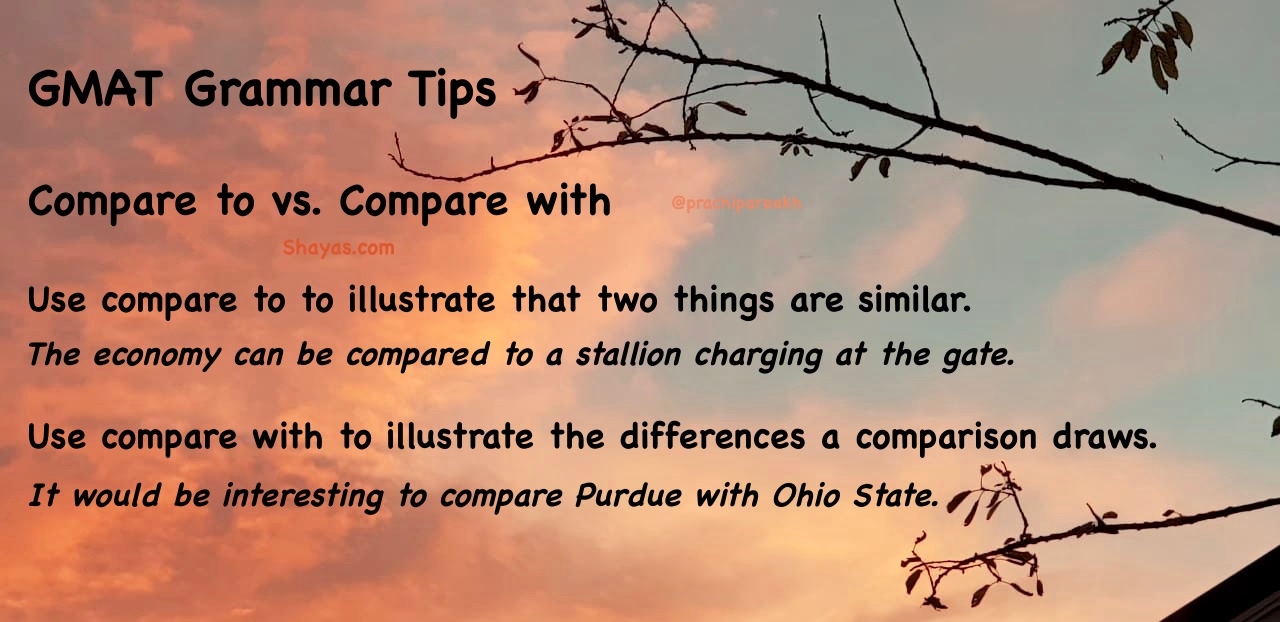
Compare to is used to liken two things or to put them in the same category. You should use compare to when you intend to simply assert that two things are alike. Use compare to to illustrate that two things are similar.
- The economy can be compared to a stallion charging at the gate.
- I compare getting comments from students in class to pulling teeth.
- She compared her work for women's rights to Susan B. Anthony's campaign for women's suffrage.
- The American economy can be compared with the European economy to note how military history impacts future economics.
- It would be interesting to compare Purdue with Ohio State.
- Ann has a 3.5 GPA, compared with Jim's 2.9.
Thursday, September 14, 2006
Agreement of Verb with Collective Nouns
In my post on Subject Verb Agreement I had already mentioned this rule. On request from many students, I am explaining this particular concept in detail.
A collective noun is a noun that represents a group or a collection of objects usually considered as a unit. Words like crowd, troop, herd, people, flock, and jury are collective nouns.
A collective noun that is singular in meaning requires a singular verb. A collective noun that is plural in meaning requires a plural verb.
If the collective noun in a particular sentence represents the individuals acting as a unit, the noun is singular. If the sentence indicates clearly that the individuals are acting seperately, the noun is plural.
e.g -
1). The committee is opposed to the plan. (acting as a unit)
2). The board of directors is in session. (as a unit)
3). The jury returned its verdict. (as a unit)
4). The jury have returned to their homes. (as individuals)
5). The family have given their contributions. (as individuals)
In most cases where the individuals composing a group are acting seperately, it is better to use such expressions as the members of the jury, the members of the family, etc. These expressions sound better and clearly indicate that the individuals are acting seperately.
1). The members of the jury have returned to their homes.
2). The members of the band wore their uniforms.
3). The people in the audience waved their hands.
A collective noun is a noun that represents a group or a collection of objects usually considered as a unit. Words like crowd, troop, herd, people, flock, and jury are collective nouns.
A collective noun that is singular in meaning requires a singular verb. A collective noun that is plural in meaning requires a plural verb.
If the collective noun in a particular sentence represents the individuals acting as a unit, the noun is singular. If the sentence indicates clearly that the individuals are acting seperately, the noun is plural.
e.g -
1). The committee is opposed to the plan. (acting as a unit)
2). The board of directors is in session. (as a unit)
3). The jury returned its verdict. (as a unit)
4). The jury have returned to their homes. (as individuals)
5). The family have given their contributions. (as individuals)
In most cases where the individuals composing a group are acting seperately, it is better to use such expressions as the members of the jury, the members of the family, etc. These expressions sound better and clearly indicate that the individuals are acting seperately.
1). The members of the jury have returned to their homes.
2). The members of the band wore their uniforms.
3). The people in the audience waved their hands.
Thursday, August 24, 2006
Special case of Agreement
The words like "half" , "part" etc are singular or plural according to the meaning of the sentence. When these words refer to a mass or a section, they are singular. When they refer to a number of individuals or things, they are plural.
e.g -
1. Half of the boys are in camp. (number -- plural)
2. Half of the pie is left. (mass or section -- singular)
3. Part of the roof was destroyed. (mass or section -- singular)
4. Part of the guests have arrived. (number -- plural)
e.g -
1. Half of the boys are in camp. (number -- plural)
2. Half of the pie is left. (mass or section -- singular)
3. Part of the roof was destroyed. (mass or section -- singular)
4. Part of the guests have arrived. (number -- plural)
Saturday, August 19, 2006
Do vs Make
1. Do - for indefinite activities e.g with words like thing, something, nothing, anything, what. e.g
a). Do something!
b). What shall we do?
c). Then Ram did a very strang thing.
2. Do - when we talk about work and jobs. e.g
a). I'm not going to do any work today.
b). It's time to do the accounts.
c). I would't like to do your job.
3. We use do...... ing structure to talk about activities that take a certain time, or are repeated. Usually there is a determiner (e.g the, my, some ) before the -ing form. Verb after do cannot have object in this structure.But do can be used with a compound noun that includes verb + object. e.g
a). During the holidays I'm going to do some walking and a lot of reading.
b). I'm going to watch some TV.
c). I want to do some bird-watching this weekend.
4. Make - we use make to talk about constructing, building, creating etc.e.g
a). My father and I once made a boat.
b). Let's make a plan.
5. Common fixed expressions
do good, harm, business, one's best, a favour, sport, exercise, one's hair, one's teeth, one's duty.
make a journey, an offer, arrangements, a suggestion, a decision, an attempt, an effort, an excuse, an exception, a mistake, a noise, a phone call, money, a profit, a fortune, peace, love, war, bed, a fire, progress.
6. After make + object, we use the infinitive without to. e.g
I made her cry. (not - I made her to cry. or I made her crying)
The infinitive must follow the object. e.g
I can't make the television work. ( not - I can't make work the television)
In passive constructions the infinitive with to is used. e.g
Ram was made to repeat the whole story.
7. In some cases make can be followed by myself, yourself etc and a past participle. This structure is common with understood and heard. e.g
She had to shout to make herself heard.
8. We can talk about an effect or change with make + object + adjective/noun . e.g
The rain made the grass wet. ( not - The rain made wet the grass).
We do not use make ... be in this structure.
You have made me a happy man. ( not - You have made me be a happy man).
a). Do something!
b). What shall we do?
c). Then Ram did a very strang thing.
2. Do - when we talk about work and jobs. e.g
a). I'm not going to do any work today.
b). It's time to do the accounts.
c). I would't like to do your job.
3. We use do...... ing structure to talk about activities that take a certain time, or are repeated. Usually there is a determiner (e.g the, my, some ) before the -ing form. Verb after do cannot have object in this structure.But do can be used with a compound noun that includes verb + object. e.g
a). During the holidays I'm going to do some walking and a lot of reading.
b). I'm going to watch some TV.
c). I want to do some bird-watching this weekend.
4. Make - we use make to talk about constructing, building, creating etc.e.g
a). My father and I once made a boat.
b). Let's make a plan.
5. Common fixed expressions
do good, harm, business, one's best, a favour, sport, exercise, one's hair, one's teeth, one's duty.
make a journey, an offer, arrangements, a suggestion, a decision, an attempt, an effort, an excuse, an exception, a mistake, a noise, a phone call, money, a profit, a fortune, peace, love, war, bed, a fire, progress.
6. After make + object, we use the infinitive without to. e.g
I made her cry. (not - I made her to cry. or I made her crying)
The infinitive must follow the object. e.g
I can't make the television work. ( not - I can't make work the television)
In passive constructions the infinitive with to is used. e.g
Ram was made to repeat the whole story.
7. In some cases make can be followed by myself, yourself etc and a past participle. This structure is common with understood and heard. e.g
She had to shout to make herself heard.
8. We can talk about an effect or change with make + object + adjective/noun . e.g
The rain made the grass wet. ( not - The rain made wet the grass).
We do not use make ... be in this structure.
You have made me a happy man. ( not - You have made me be a happy man).
Do - Substitute verb
Do - Substitute Verb - (auxiliary verb + do) - In British English (but not American), do can be used alone as a substitute verb after an auxiliary verb. e.g
a). He smokes more than he used to - American english
He smokes more than he used to do.- British English
b). Do you think Phil will come? ~ He might.- American english
Do you think Phil will come? ~ He might do.- British English
a). He smokes more than he used to - American english
He smokes more than he used to do.- British English
b). Do you think Phil will come? ~ He might.- American english
Do you think Phil will come? ~ He might do.- British English
Do - auxiliary verb
The auxiliary verb "do" - followed by infinitives without "to". It has several uses, one of them -- Ellipsis
In cases where an auxiliary verb is used instead of a whole verb phrase, "do" is common in affirmative clause, questions and negatives. e.g
a). She doesn't like singing , but I do.
b). You saw Ram, didn't you?
c). Emil thinks there's something wrong with Ann, and so do I.
NOTE -
An auxiliary verb combines with another verb to help form the tense, mood, voice, or condition of the verb it combines with.
The verbs to have, to be, to do, will, shall, would, should, can, may, might, and could are the common auxiliary verbs in English.
Auxiliary verbs are sometimes called helping verbs.
Ellipsis - We often leave out words to avoid repetition, or in other cases when the meaning can be understood without them. This is called ellipsis.
In cases where an auxiliary verb is used instead of a whole verb phrase, "do" is common in affirmative clause, questions and negatives. e.g
a). She doesn't like singing , but I do.
b). You saw Ram, didn't you?
c). Emil thinks there's something wrong with Ann, and so do I.
NOTE -
An auxiliary verb combines with another verb to help form the tense, mood, voice, or condition of the verb it combines with.
The verbs to have, to be, to do, will, shall, would, should, can, may, might, and could are the common auxiliary verbs in English.
Auxiliary verbs are sometimes called helping verbs.
Ellipsis - We often leave out words to avoid repetition, or in other cases when the meaning can be understood without them. This is called ellipsis.
Friday, August 18, 2006
Less vs Fewer
1). Less and Fewer -- Difference -
Less is the comparative of little ( used especially before uncountable nouns).
e.g - I earn less money than you.
Whereas
Fewer is the comparative of few ( used before plural nouns)
e.g - I've got fewer problems than I used to have.
2). Less of and fewer of - used before determiners such as the,, my, this and before pronouns.
e.g - At the college reunions, there are fewer of us each year.
I'd like to spend less of my time answering mails.
* Before nouns without determiners, of is not used.
e.g - If you want to lose weight, eat less food. (NOT less of food)
3). Nouns can be dropped after less and fewer if the meaning is clear.
e.g - Some people go to church, but less/fewer than 20 years ago
* Less can be used as an adverb (the opposite of adverb more)
e.g - I worry less than I used to.
4). Lesser - used to mean "smaller" or "not so much"
e.g - the lesser of two evils.
GMAT Examples - Sentence No 49 at the link below
http://gmatsentencecorrection.blogspot.com
5) Use less when referring to statistical or numerical expressions.
e.g:
Sara is less than five feet tall
Your issue essay should be a thousand words or less
NOTE: It's possible to regard the quantities as sums of countable measures
Less is the comparative of little ( used especially before uncountable nouns).
e.g - I earn less money than you.
Whereas
Fewer is the comparative of few ( used before plural nouns)
e.g - I've got fewer problems than I used to have.
2). Less of and fewer of - used before determiners such as the,, my, this and before pronouns.
e.g - At the college reunions, there are fewer of us each year.
I'd like to spend less of my time answering mails.
* Before nouns without determiners, of is not used.
e.g - If you want to lose weight, eat less food. (NOT less of food)
3). Nouns can be dropped after less and fewer if the meaning is clear.
e.g - Some people go to church, but less/fewer than 20 years ago
* Less can be used as an adverb (the opposite of adverb more)
e.g - I worry less than I used to.
4). Lesser - used to mean "smaller" or "not so much"
e.g - the lesser of two evils.
GMAT Examples - Sentence No 49 at the link below
http://gmatsentencecorrection.blogspot.com
5) Use less when referring to statistical or numerical expressions.
e.g:
Sara is less than five feet tall
Your issue essay should be a thousand words or less
NOTE: It's possible to regard the quantities as sums of countable measures
Monday, July 31, 2006
When to use the Passive voice ????
Active voice is the better form to use. As a rule, the active voice is preferred for business writing, and for any other form of writing that requires the direct approach. The use of active voice increases vividness.
However, the passive voice is generally used when the subject of the sentence is indefinite, general, or unimportant. In the sentence, They mine coal in Pennysylvania, the subject is so indefinite that it is not clear what is meant by they. It might mean the miners, the people, or the companies.This sentence, and sentences like it, are improved by putting the verb in the passive voice.
They mine coal in Pennysylvania. (Poor)
Coal is mined in Pennysylvania. (Better)
They grow wheat in many of our states. (Poor)
Wheat is grown in many of our states. (Better)
The passive voice is also used when what was done is more important than doer of the action. Study the following sentences:
The play, "Man and Superman," was written by Shaw. (Passive)
Shaw wrote the play "Man and Superman." (Active)
America was discovered by Columbus. (Passive)
Columbus discovered America. (Active)
In the first sentence, if you wish to emphasize the play more than the author, put the verb in the passive voice. In the third sentence , if you wish to emphasize the discovery more than the discoverer, put the verb in the passive voice.
The use of the passive voice is generally used when you want to emphasize the receiver rather than the doer. However, in the majority of cases the active voice is more effective than the passive voice.
Note - In general, one should avoid passive voice in GMAT, passive voice form may appear in a correct answer choice - especially in science, medical and technical writing styles.
The passive voice is required when the non - underlined part of the sentence contains the person or agent performing the action preceded by the word by.
e.g - The shuttle launch seen around the world by people of all ages, all races, and all religions.
This sentence is missing a verb, and it is therefore a fragment. Because the people who are seeing the launch are at the end of the sentence, preceded by the word by, we must use the passive voice to complete this sentence:
The shuttle launch WAS seen sround the world by people of all ages, all races, and all religions.
The link below also deals with usage of passive in GMAT sentence correction
Link to test magic forum - passive construction on GMAT
However, the passive voice is generally used when the subject of the sentence is indefinite, general, or unimportant. In the sentence, They mine coal in Pennysylvania, the subject is so indefinite that it is not clear what is meant by they. It might mean the miners, the people, or the companies.This sentence, and sentences like it, are improved by putting the verb in the passive voice.
They mine coal in Pennysylvania. (Poor)
Coal is mined in Pennysylvania. (Better)
They grow wheat in many of our states. (Poor)
Wheat is grown in many of our states. (Better)
The passive voice is also used when what was done is more important than doer of the action. Study the following sentences:
The play, "Man and Superman," was written by Shaw. (Passive)
Shaw wrote the play "Man and Superman." (Active)
America was discovered by Columbus. (Passive)
Columbus discovered America. (Active)
In the first sentence, if you wish to emphasize the play more than the author, put the verb in the passive voice. In the third sentence , if you wish to emphasize the discovery more than the discoverer, put the verb in the passive voice.
The use of the passive voice is generally used when you want to emphasize the receiver rather than the doer. However, in the majority of cases the active voice is more effective than the passive voice.
Note - In general, one should avoid passive voice in GMAT, passive voice form may appear in a correct answer choice - especially in science, medical and technical writing styles.
The passive voice is required when the non - underlined part of the sentence contains the person or agent performing the action preceded by the word by.
e.g - The shuttle launch seen around the world by people of all ages, all races, and all religions.
This sentence is missing a verb, and it is therefore a fragment. Because the people who are seeing the launch are at the end of the sentence, preceded by the word by, we must use the passive voice to complete this sentence:
The shuttle launch WAS seen sround the world by people of all ages, all races, and all religions.
The link below also deals with usage of passive in GMAT sentence correction
Link to test magic forum - passive construction on GMAT
Monday, July 17, 2006
Forms of Verb 1 - Infinitive
What is infinitive form of verb? - It is of the form to + simple form of verb.e.g - to take ; to surprise.
Uses of the Infinitive -
1). After a verb - Verbs such as want, promise, plan, manage, forget, choose, prove, hope, pretend, need, expect, decide are followed immediately by an infinitive.
They expect to win the game.
She needs to apply for a scholarship.
2). After verb and object - With verbs that take an object, such as force, allow, believe, need, persuade, urge, expect, want, the infinitive follows the object.
She persuaded us to wait.
She urged her supporters not to leave.
3). After certain adjectives and nouns - Adjectives such as anxious, sorry, easy, difficult, right, wrong, can be followed by infinitives.
It is easy (for you) to get to my house.
He was eager to meet his new boss.
Some nouns (such as way, place, time, decision, job, aim) are frequently followed by an infinitive.
He has no place to relax.
It is time to go.
4). To express purpose
He is working at night (in order) to earn more money.
The Infinitive Without to
The infinitive form without to is used in the following idiomatic expressions.
1). After a causative make, let , have + object
He made his sister drive the whole way.
He had her pay for the gas, too.
2). After the verb help
They helped us solve the problem.
Uses of the Infinitive -
1). After a verb - Verbs such as want, promise, plan, manage, forget, choose, prove, hope, pretend, need, expect, decide are followed immediately by an infinitive.
They expect to win the game.
She needs to apply for a scholarship.
2). After verb and object - With verbs that take an object, such as force, allow, believe, need, persuade, urge, expect, want, the infinitive follows the object.
She persuaded us to wait.
She urged her supporters not to leave.
3). After certain adjectives and nouns - Adjectives such as anxious, sorry, easy, difficult, right, wrong, can be followed by infinitives.
It is easy (for you) to get to my house.
He was eager to meet his new boss.
Some nouns (such as way, place, time, decision, job, aim) are frequently followed by an infinitive.
He has no place to relax.
It is time to go.
4). To express purpose
He is working at night (in order) to earn more money.
The Infinitive Without to
The infinitive form without to is used in the following idiomatic expressions.
1). After a causative make, let , have + object
He made his sister drive the whole way.
He had her pay for the gas, too.
2). After the verb help
They helped us solve the problem.
Thursday, July 13, 2006
Whether vs. If
Using Whether and If
1). After Prepositions , we use only whether.
- I haven't settled the question of whether I'll go back home.
- There was a big argument about whether we should move to a new house.
2). Whether, not if, is used before infinitives.
- They can't decide whether to get married now or wait.
3). When a question-word clause is a subject or complement, whether is preferred.
- Whether we can stay with my mother is another matter. - (Subject)
- The question is whether the man can be trusted. - (Complement)
- The question is if the man can be trusted. - Correct but less preferred.
4). If an indirect question is fronted , whether is used.
- Whether I'll have time I'm not sure at the moment.
5). Whether is generally preferred in a two-part question with or.
- The Directors have not decided whether they will recommend a dividend or reinvest the profits.
6). After verbs that are more common in a formal style, whether is preferred.
- We discussed whether we should close the shop.
7). Whether and if both can introduce indirect questions.
- I'm not sure whether/ if I'll have time.
8). Yes/ No questions are reported with if or whether.
- I don't know if/ whether I can help you.
Note - The word IF does not always signal a conditional sentence. In such cases, GMAT prefers "whether" instead of "if"
- I don't know if I will go to the dance. (Incorrect)
- I don't know whether I will go to the dance. (Correct)
Click on link below and view sentence no. 45 and 46 for the above rule.
http://gmatsentencecorrection.blogspot.com
Monday, July 10, 2006
because vs. because of
1). Because is a conjunction, used at the beginning of a clause, before a subject and a verb.
We were late because it rained.
I'm happy because I met you.
2). Because of is a two - word preposition used before a noun or a pronoun.
We were late because of the rain.
I'm happy because of you.
Note: "Because" and its clause can go after or before the main clause.
I finished early because I worked fast.
Because I worked fast, I finished early.
View sentence number 48 at the link below
http://gmatsentencecorrection.blogspot.com
Sunday, July 09, 2006
It -- as subject of a sentence
The Third Person It as Subject of a sentence
It as a subject of a sentence can be used in two different ways.
1). As an empty or meaningless word in expressions that concern the time or the weather:
It is one o'clock.
It is raining.
It will soon be supper time.
It is frosty.
2). As the formal subject of a sentence, referring to the deferred real subject that follows the verb:
It is useless to wait. (deferred subject - to wait)
It is a pity that you must go. (deferred subject - that you must go)
In sentences where it refers to a deferred subject, the latter can be moved to the normal position preceding the verb;
To wait is useless.
That you must go is a pity.
Below is a link that further explains usage of It in simple language.
Using It
It as a subject of a sentence can be used in two different ways.
1). As an empty or meaningless word in expressions that concern the time or the weather:
It is one o'clock.
It is raining.
It will soon be supper time.
It is frosty.
2). As the formal subject of a sentence, referring to the deferred real subject that follows the verb:
It is useless to wait. (deferred subject - to wait)
It is a pity that you must go. (deferred subject - that you must go)
In sentences where it refers to a deferred subject, the latter can be moved to the normal position preceding the verb;
To wait is useless.
That you must go is a pity.
Below is a link that further explains usage of It in simple language.
Using It
Subscribe to:
Posts (Atom)