Showing posts with label gmat idioms. Show all posts

Monday, July 13, 2020

Idiomatic Usage: grounds for


grounds for (something)

The basis for some action or decision, often one that is disciplinary or legal in nature.

  • Be careful now—plagiarism is grounds for expulsion.
  • Your negligence is grounds for a lawsuit. 
  • Is infidelity grounds for divorce in this state?


Tuesday, June 23, 2020

introduce to vs. introduce into


introduce to: to present someone to someone else for the first time so that they can become acquainted

  • I would like to introduce you to my cousin, Sarah.
  • We proudly introduce to you the Dutch team.
  • Let me introduce you to him.

introduce into: to put something into use for the first time, or to put something into a new place

  • New computers have been introduced into the office.
  • The grey squirrel was introduced into Britain from North America.
  • Fuel was introduced into the jet pipe.


Sunday, June 07, 2020

Usage: advise...to vs. advise that


Use advise...to when the sentence is giving advice directly to someone or something. If you advise someone to do something, you tell them what you think they should do.

  • I advise you to go home. (I am giving this advice directly to you.)
  • Sam advised Sarah to sell her car. (Sam advised Sarah directly)
  • The minister advised him to leave as soon as possible

Use advise that when the sentence is giving advice not directed at any particular person or thing.

  • Experts advise that sunscreen should be reapplied on an hourly basis. (The experts are not giving this advice directly to people; the advice is being given to all of us.)
  • Experts advise that investors sell their stock in the company. (The experts are not giving this advice directly to the investors; the advice is being given to all of us.)


Tuesday, May 26, 2020

Rates for vs. Rates of


When rates means prices charged, it should be followed by for instead of of

State officials report that soaring rates for liability insurance are forcing cutbacks in the operations of everything from local governments and school districts to day-care centers and recreational facilities. - correct

State officials report that soaring rates of liability insurance are forcing cutbacks in the operations of everything from local governments and school districts to day-care centers and recreational facilities. - incorrect


When rate is used as a standard of measure, it should be followed by of instead of for

High rates of sick leave are a concern for all types of organizations. - correct

High rates for sick leave are a concern for all types of organizations. - incorrect


Tuesday, March 17, 2020

Look at vs. Look to

Look at implies to turn the eyes in a certain direction so as to see; to use one's sight.
  • He turned and looked at her.
  • I’d like a skin specialist to look at that rash of yours.

Look to (someone or something) implies To rely on, turn to or refer to them or it, to expect

  • Children look to their parents for help.
  • This looks to be a very difficult assignment.

Friday, September 15, 2006

Compare to vs. Compare with


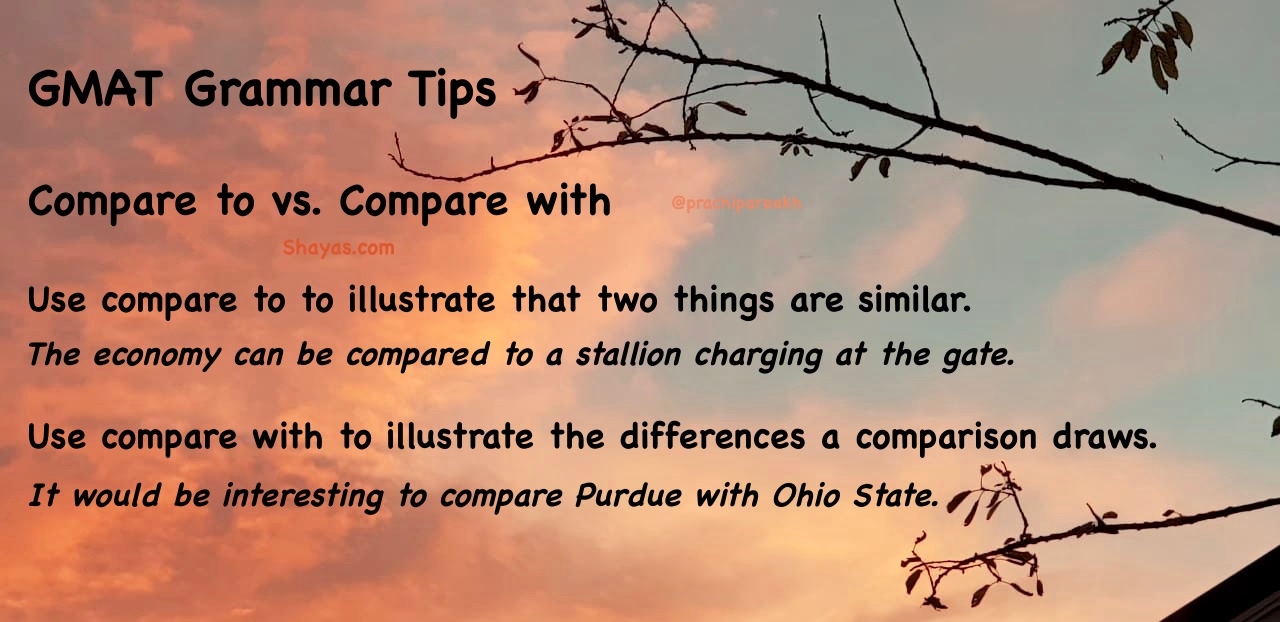
Compare to is used to liken two things or to put them in the same category. You should use compare to when you intend to simply assert that two things are alike. Use compare to to illustrate that two things are similar.
  1. The economy can be compared to a stallion charging at the gate.
  2. I compare getting comments from students in class to pulling teeth.
  3. She compared her work for women's rights to Susan B. Anthony's campaign for women's suffrage.
Compare with is used to place two things side by side for the purpose of examining their similarities or differences. Use compare with to illustrate the differences a comparison draws.
  1. The American economy can be compared with the European economy to note how military history impacts future economics.
  2. It would be interesting to compare Purdue with Ohio State.
  3. Ann has a 3.5 GPA, compared with Jim's 2.9.